
A Client Onboarding Checklist for Freelancers With ADHD
The client says yes. You feel good for about an hour. Then the work starts arriving in pieces: a brief in an email, brand colours in a Slack message, three logins on a sticky note, a phone call where they mention a deadline nobody wrote down. Two weeks later you are rebuilding something because the version you were given turned out to be the old one.
Almost every freelance project that goes wrong went wrong in week one. Not because anyone behaved badly, but because nothing was decided out loud. With ADHD that gap costs more than it costs other people, because the details you did not write down are the details that are gone. Onboarding is the one part of a project where half an hour of admin buys you months of not having to remember things.
Here is the version I would keep taped to the wall.
1. Put the scope in one place, in writing
Not a contract necessarily, though a contract is better. Just one document, or one email, that says what you are making, what is not included, when it lands, and what it costs. If the conversation happened on a call, you are the one who writes it up afterwards.
The sentence that does the most work is the one about what is not included. "Two rounds of revisions, further rounds quoted separately" prevents an argument in six weeks that neither of you will enjoy. So does "copy supplied by you" if you are not writing it.
Send it and ask them to reply confirming. That reply is the thing you point back to later, kindly, when the project starts growing.
2. Settle the money before you start the work
Deposit terms, payment terms, invoice address, and the name that needs to be on the invoice. All of it goes in the first week, while everyone is enthusiastic and nobody is chasing anything.
Asking for a deposit after you have already started feels awkward, so most people skip it and then spend the project quietly anxious. Asking before you start is completely normal and nobody blinks. Fifty percent up front on a fixed project, or the first month in advance on a retainer, is standard in most of the freelance world.
Get the practical details too. Some companies pay only against a purchase order number. If you learn that in month three, you are two invoices behind before you find out.
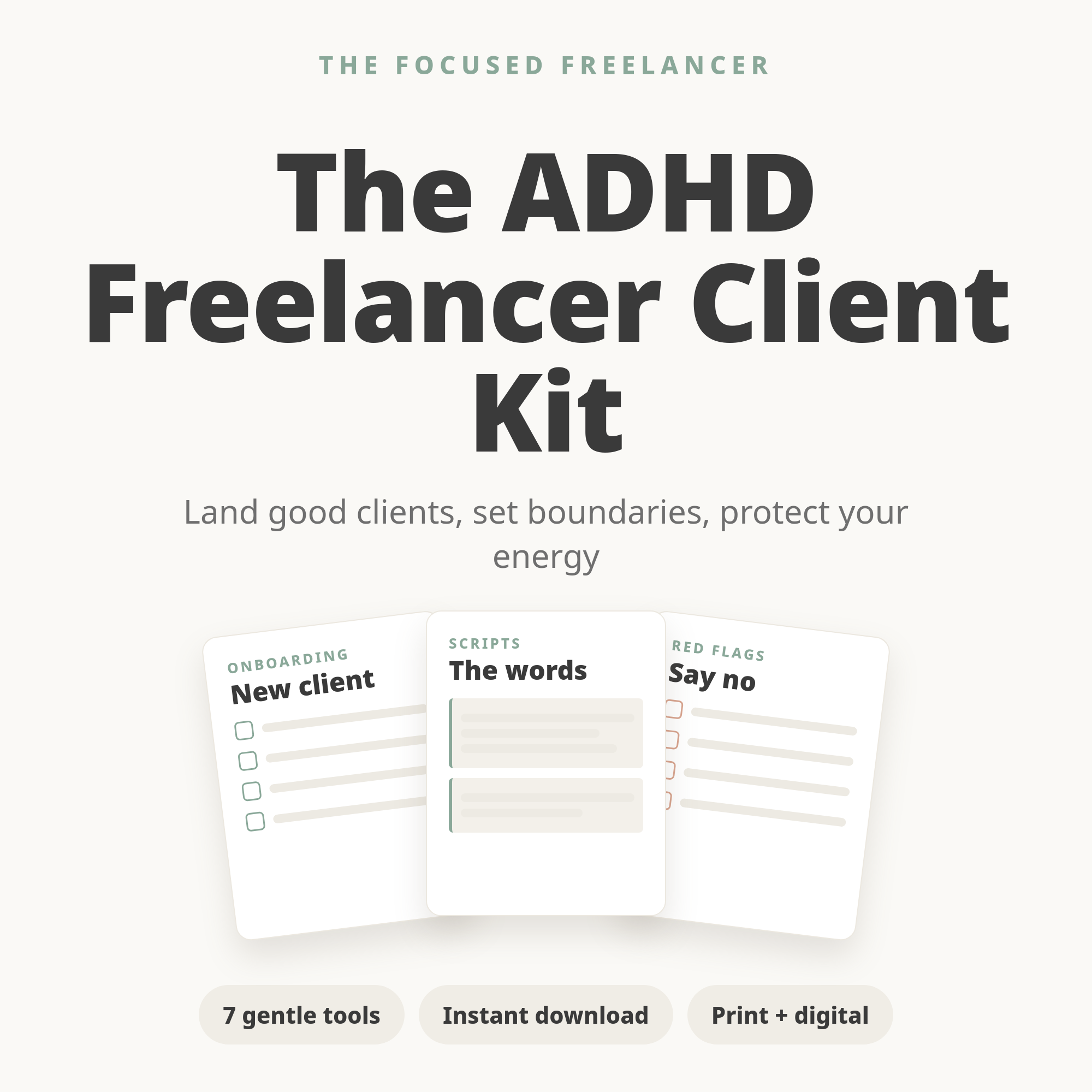
Want the whole first week already written? The Client Kit has the onboarding pages ready to fill in: a scope sheet, a welcome email, an asset request list and a boundaries page you can hand over on day one.
3. Ask for everything you need in a single list
Requests that dribble out one at a time are the fastest way to lose a fortnight. Send one list, numbered, with a date on it, and say plainly that the timeline starts when the last item arrives.
Typical list for a project of any size:
- Logo files, in vector if they have them, plus the fonts and hex codes
- Logins for anything you need to touch, sent through a password manager rather than email
- Existing copy, photography, or data, and confirmation of who owns it
- The name of the person who signs things off, and whether anyone else has a veto
- Examples of work they like, and one they dislike, which is usually more useful
- Any hard dates: a launch, a print run, a board meeting
That last one about veto power is worth asking directly. Discovering a silent stakeholder at the final review is how three rounds of revisions become nine.
4. Agree where the conversation happens
One channel for the project, and one place where decisions live. It matters for everyone, and it matters twice as much for a brain that will not remember whether the thing was agreed in email, in Slack, or on a call at eight in the evening.
Say it out loud in the welcome email: everything project related by email, or everything in the shared channel, your choice. Then add your hours and roughly how fast you reply. "I answer messages between nine and five on weekdays, usually within a day" is not a rule you are imposing on them. It is information that stops them wondering, and it stops you feeling obliged to answer at eleven on a Sunday.
5. Put the check-ins in the calendar now
Book them while you are setting everything else up, even if they feel unnecessary. A fifteen minute call every second Friday, or a written update every Monday morning, whichever suits the work.
Regular contact is the cheapest insurance there is. Clients rarely get nervous because a project is behind. They get nervous because they have not heard from you and cannot tell. A dull update saying the thing is on track is worth more than it looks.
It also protects you from the other failure mode, where you disappear into the work, resurface after three weeks, and discover you built the wrong thing.
6. Write down the first task before you close the tab
This is the small one that matters most. At the end of the setup, while everything is still in your head, write the single next physical action somewhere you will see it. Not "start the project." Something like "open the brand files and set up the document."
The gap between finishing onboarding and starting the work is where projects stall for a week. Leaving yourself an obvious first move closes it.
The welcome email
One message, sent the day they say yes, that does most of the above at once.
Hi [name],
Great to be working together. Here is everything in one place so nothing gets lost.
What I am doing: [one or two lines of scope]. This includes [X], and does not include [Y], which I am happy to quote separately if you want it later.
Timing: first draft with you by [date], final by [date], assuming the items below land by [date].
Money: [total], with [50%] due before I start. Invoice attached. Let me know if you need a PO number on it.
What I need from you: [numbered list].
How we keep in touch: email is best for anything project related so decisions stay in one place. I work [days and hours] and usually reply within a day. I have put a short check-in call in your calendar for [date].
Anything look wrong, tell me now rather than later.
[your name]
It reads as organised rather than rigid, which is the tone you want. Every boundary in it is delivered as logistics, not as a warning.
When the client goes quiet during onboarding
It happens constantly. They were keen on Tuesday and by the following Wednesday you have had nothing. Do not read it as trouble, and do not start the work anyway to be helpful.
Send one short chase, and put a date in it.
Hi [name], just checking in on the list from last week. Once the logins and the copy are through I can get started, and I am holding [dates] for you until [date]. After that I would need to move the schedule back a couple of weeks.
Holding a slot with an expiry date is honest, it is not a threat, and it works far better than asking again more politely.
Set up every new client the same way. The Complete Bundle puts all three kits together: the Client Kit for onboarding and boundaries, the Money Kit for rates and invoices, and the Focus Kit for the days the work will not start.
The takeaway
Onboarding is not paperwork you do for the client. It is the version of your memory that lives outside your head, written down once so you never have to reconstruct it. Scope in one document. Money settled before day one. One list of assets. One channel. Check-ins booked. First task written down.
Half an hour, and the project stops depending on what you happen to remember.