ADHD Task Paralysis: Why You Freeze, and How to Start Anyway
The task is not hard. You have done it a hundred times. It is right there on the list, it will take maybe forty minutes, and the client is waiting. And you cannot start. You sit in front of it, aware of every passing minute, and something in you simply will not move. Then the guilt arrives, which somehow makes starting even less possible.
This is task paralysis, and it is one of the least talked about parts of freelancing with ADHD. It looks like procrastination from the outside, so people treat it like a discipline problem. It is not. It is a stall, and stalls respond to different tools than laziness does.
Why the freeze happens
An ADHD brain runs on interest, urgency, novelty, and challenge rather than on importance alone. When a task has none of those, there is no fuel to start it, no matter how much your rational mind agrees it matters. Add the usual freelance extras, an unclear first step, a fear of doing it badly, too many options with no external boss to pick one, and you get a brain that would rather do nothing than choose wrong.
The freeze is not a character flaw. It is what happens when a task is too vague, too big, or too loaded for the amount of activation your brain can produce right now. Every fix below works by changing one of those three things.
1. Say the next physical action out loud
Not the task. The action. "Write the newsletter" is a project your brain cannot grip. "Open the doc and type a subject line" is a movement your hands can make. Say it out loud, because hearing it makes it concrete in a way that reading a list item does not. If the sentence you say still sounds like a project, cut it smaller.
2. Give yourself five minutes and mean it
Set a timer for five minutes and agree with yourself that you can stop when it rings, genuinely stop, no guilt. Most of the time you will keep going, because the resistance lives at the start and not in the middle. But the deal only works if it is real. Break the promise a few times and your brain stops believing the offer.
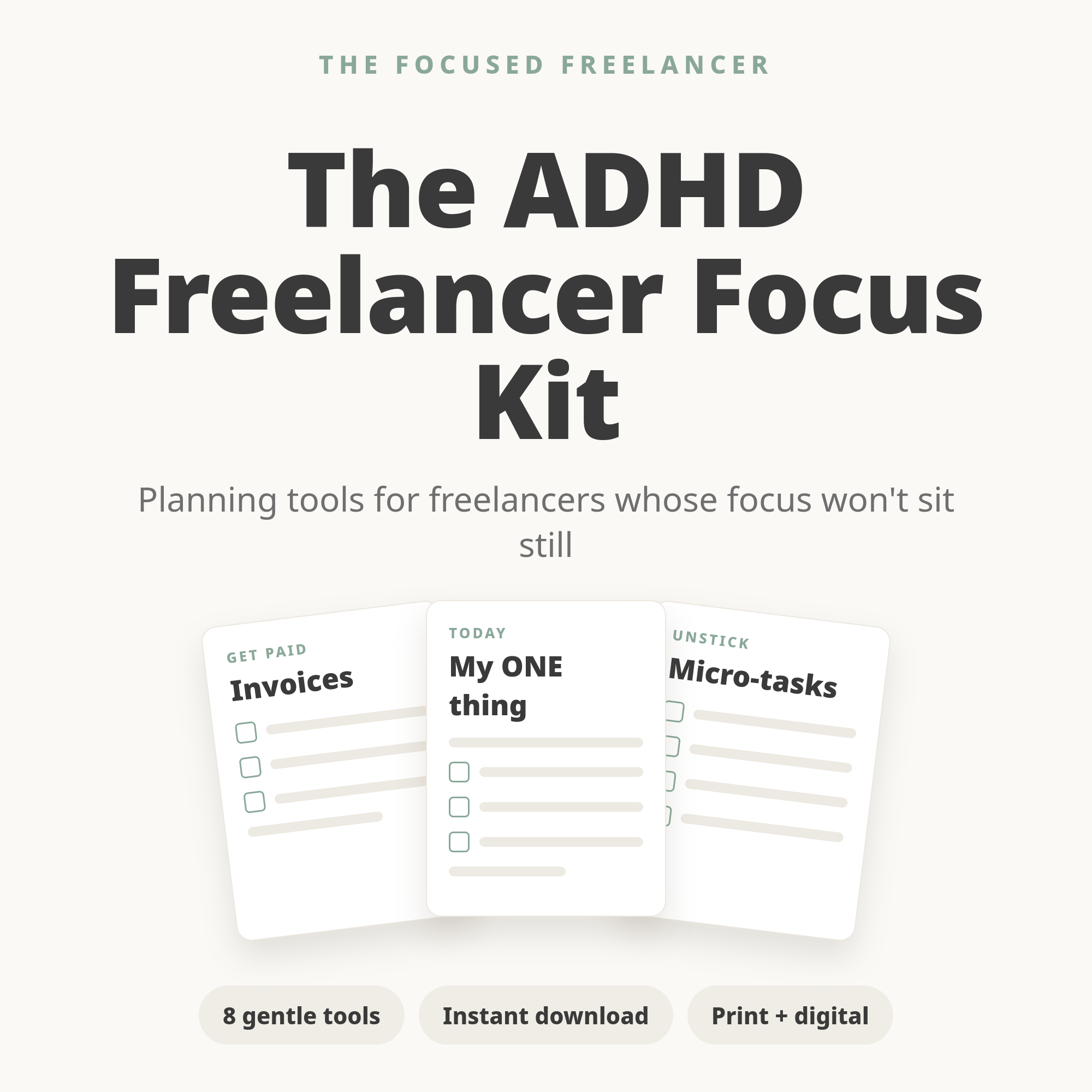
Frozen more days than not? The Focus Kit has a project unstick page that walks a stuck task down to a single ten-minute step, plus a daily page that names your one thing before the freeze sets in.
3. Lower the quality bar on purpose
Paralysis often hides perfectionism. If the only acceptable version is the good one, starting means risking a bad one, so your brain avoids the risk entirely. Give yourself explicit permission to produce a rough, ugly, first attempt. Write the worst possible opening paragraph. Sketch the layout badly. Bad work is editable. A blank page is not.
4. Change where your body is
Sometimes the stall is physical, not mental. You have been in the same chair, in the same room, in the same slightly stale mood for hours. Move. Walk around the block, work from a different room, stand up for ten minutes. A change of state can do in five minutes what an hour of staring at the screen will not.
5. Do it with someone in the room
Body doubling is almost unfairly effective on paralysis. Someone else working nearby, in person or on a silent video call, adds a small amount of external structure and just enough social stakes to break the stall. You are not being watched, you are being accompanied, and for a stuck ADHD brain those feel completely different.
6. Start with the easiest piece, not the most important one
Conventional advice says eat the frog first. When you are frozen, that advice keeps you frozen. Do the small, dull, obvious part instead: rename the files, paste in the client's notes, set up the document. Motion creates motion. Once you are inside the work, the hard part is much easier to approach than it was from outside.
7. Ask what the task is really costing you
Some tasks are not stalled because they are boring. They are stalled because something about them is uncomfortable: a client you are avoiding, a price you regret quoting, a job you already know needs a difficult conversation. If a task keeps sliding for days, ask what is actually in the way. Often the thing to do is not the task at all, it is the email you have been dreading.
8. Log the win, however small
When you do break the freeze, note it. Not for the diary, for the evidence. ADHD memory is unkind about effort, it recalls the stalled hours and quietly deletes the part where you got up and did the thing. A short record of what unstuck you becomes a list you can use next time instead of starting from scratch.
The takeaway
Task paralysis is not a willpower shortage, so willpower is not the fix. Make the first step physically tiny, cut the quality bar, change your state, and borrow structure from other people. Freelancing with ADHD is not about never freezing. It is about knowing what melts the freeze so the frozen hour does not become a frozen week.
Give your brain a smaller thing to start. The Focus Kit is a set of printable pages built for exactly these days: one thing a day, brain-dump to micro-tasks, a project unstick sheet, and a weekly reset that keeps the guilt out of it.