How to Focus as a Freelancer With ADHD: 9 Things That Work
You know the work needs doing. The deadline is real. You even want to do it. And yet you've refreshed the same three tabs, made another coffee, and somehow it's 2pm. If that's a familiar afternoon, you're not lazy and you're not broken. You have a brain that runs on interest and urgency, and freelancing hands you a pile of tasks that often have neither until the last minute.
The good news is that focus, for an ADHD brain, is less about willpower and more about setup. When you build the right structure around a task, starting gets a lot easier. Here are nine things that genuinely help, drawn from what works for freelancers who think in circles instead of straight lines.
1. Decide your one thing before you open anything
Before the inbox, before Slack, before the group chat, answer one question on paper: if only one thing gets done today, what is it? Not five things. One. An ADHD brain will happily spread itself across a dozen half-tasks and finish none of them. Naming the single task that matters gives the day an anchor, and it quietly gives you permission to let the smaller stuff wait.
2. Brain-dump first, then find the ten-minute step
A big project feels impossible because your brain is holding all of it at once: the research, the draft, the revisions, the client's opinion, the thing you're secretly avoiding. Get it out of your head and onto a page. Write down everything the project involves, messily, no order needed.
Then ignore all of it except one line: what is the very next step, and can it take under ten minutes? Not "build the website." Open the file and name the first section. Starting is the hard part for an ADHD brain, and a ten-minute step is small enough to slip past the resistance.
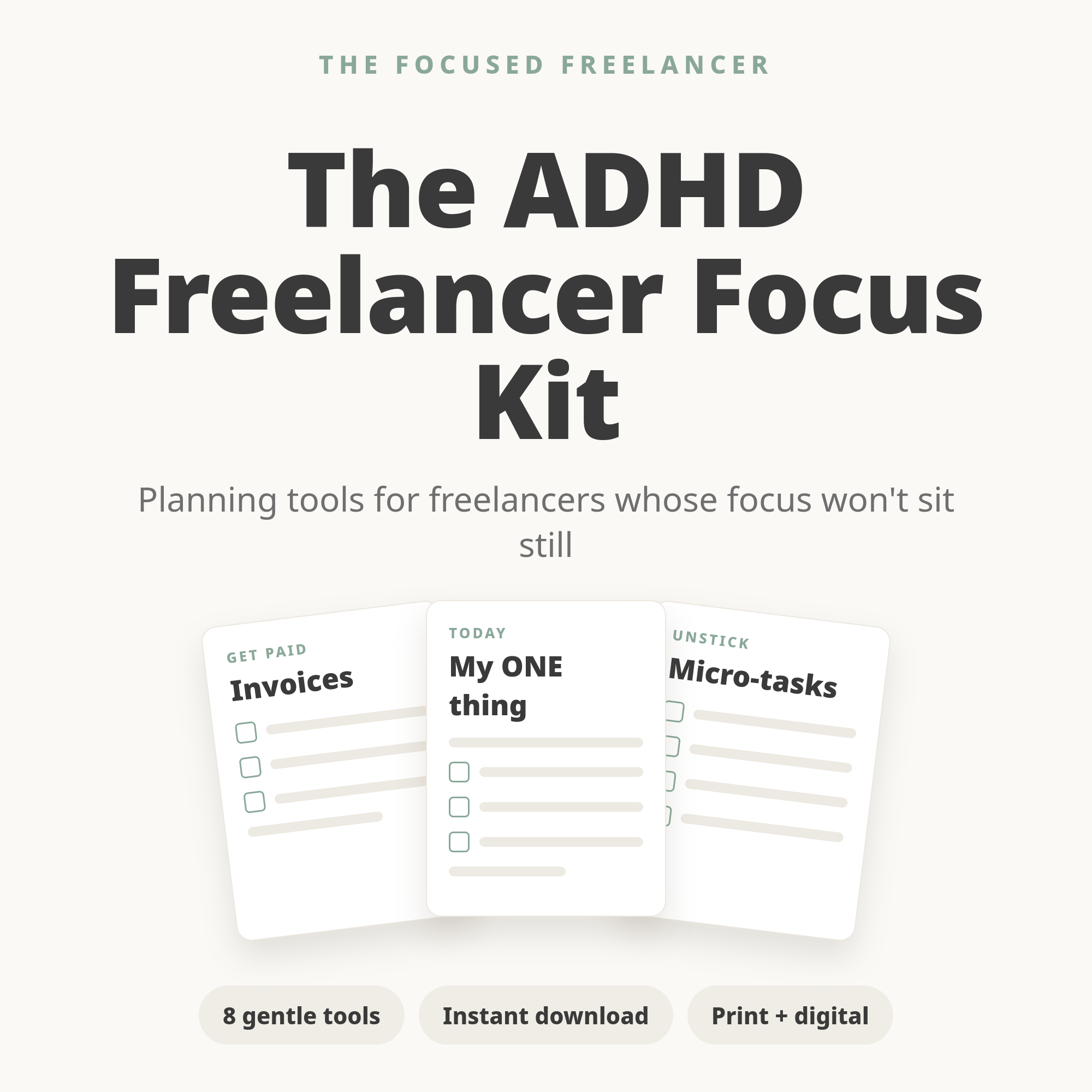
Want this already laid out for you? The Focus Kit turns this exact routine into fill-in pages: a daily one-thing page and a brain-dump to micro-tasks sheet, so you're not building the system every morning, just using it.
3. Borrow someone else's focus with body doubling
Body doubling means working alongside another person, even silently, even over a video call, while you each do your own thing. It sounds too simple to matter. It works anyway. The quiet presence of someone else raises the stakes just enough to keep you in your seat. Book a co-working call with a freelancer friend, join a virtual focus room, or sit in a cafe where leaving mid-task feels a bit awkward.
4. Timebox with a timer you can actually see
Open-ended time is quicksand for an ADHD brain. "Work on the project this afternoon" has no edges, so it never really starts. A visible countdown gives the task edges. Set a timer for 25 or 50 minutes, promise yourself you only have to work until it rings, and let a real break follow. The point is not to grind. It's to make the work a short, finite thing your brain can agree to begin.
5. Make starting almost embarrassingly small
When resistance is high, shrink the task until it feels too small to refuse. Not "write the proposal" but "open a blank doc and type the client's name." Momentum is the whole game. Once you're moving, staying in motion is far easier than starting was, and the tiny step often turns into twenty real minutes without you noticing.
6. Put the boring admin on templates
A lot of freelance focus leaks out through small recurring tasks: the same onboarding questions, the same follow-up email, the same check-in you rewrite from scratch every time. Write them once, save them as templates, and reuse them. Decisions you don't have to make again are focus you get to keep for the real work.
7. Protect your good hours, save admin for the dead ones
Most people have a window when focus comes more easily. Notice yours and guard it. Put your hardest creative work there and refuse to spend it on email. The low-energy hours, the post-lunch slump or the end of the day, are for the shallow admin that doesn't need much brain.
8. Deal with the invoice the moment the work ships
The ADHD tax is real, and often it's a literal one: work delivered, invoice forgotten, money left on the table for weeks. Close that loop while the project is still warm. The minute you send the final deliverable, send the invoice, or at least log it somewhere you'll actually see it.
9. End the week with a reset, not a guilt trip
Friday brains love to tally everything that didn't get done. Flip it. Spend five minutes noting three things you did finish, what drained you, what gave you energy, and one gentle intention for next week. Over time it helps you build a week that fits you instead of one you keep failing to live up to.
The honest takeaway
You don't need to become a different, tidier person to focus as a freelancer. You need structure you can lean on when motivation doesn't show up, which for an ADHD brain is often. Pick one idea from this list and try it tomorrow. A messy finished page beats a perfect blank one every time.
If building the structure is the part that never happens, that's exactly what the Focus Kit is for. It's a done-for-you set of printable pages built around everything above: daily focus, brain-dump to micro-tasks, a client overview, a get-paid tracker, and a weekly reset.