
ADHD Time Blindness: How Freelancers Can Actually Hit Deadlines
You start a task thinking it will take an hour. Three hours later you look up and the afternoon is gone. Or the deadline that felt comfortably far away is suddenly tomorrow, and you have no idea how that happened. This is time blindness, and if you freelance with ADHD it is probably costing you sleep, money, and a fair amount of self-respect.
Time blindness is not laziness or bad planning. It is a genuine difference in how an ADHD brain senses the passing of time. Time tends to exist in two settings, now and not now, with very little in between. The trouble is that freelancing runs entirely on the "in between": estimates, deadlines, and the slow build of a project over weeks. Here is how to work with that instead of getting ambushed by it.
Make time something you can see
An ADHD brain struggles to feel time, so give it something to look at. A physical timer that shows the minutes draining away works far better than a number on a phone you have to remember to check. Keep an analog clock in your eyeline. When a block of work has a visible shape, your brain can start to track it instead of losing it.
Time-block, then add a buffer you think is silly
Blocking time for tasks helps, but ADHD estimates are famously optimistic. So take your honest guess and add half again on top. If a task feels like an hour, give it ninety minutes. The goal is not to be slow, it is to stop building a day out of best-case fantasies that collapse the moment one thing runs long.
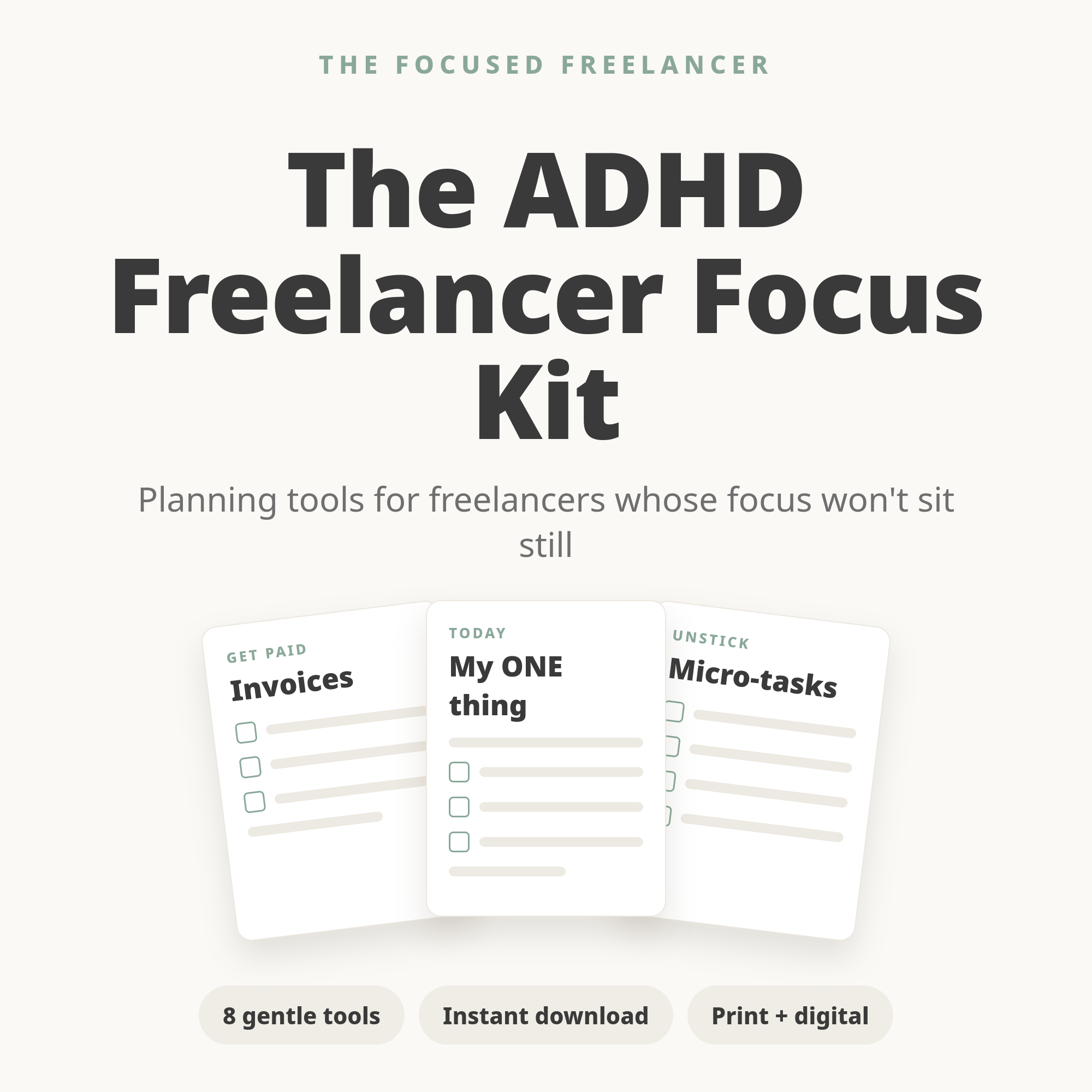
Struggling to see the shape of your day? The Focus Kit gives you daily and weekly pages that lay the day out in front of you, so time stops being invisible and your deadlines stop being surprises.
Work backwards from the deadline
A deadline three weeks out is "not now," so your brain files it under ignore. Fix that by working backwards. Take the final date and mark the steps that have to happen before it, each with its own mini-deadline. Now the project is a series of "nows" you can actually feel, not one distant cliff you sprint towards at the last second.
Keep a "how long it really took" log
You will never guess your task times accurately from memory, because your memory of them is part of the problem. So measure. For a couple of weeks, jot down what a task actually took next to what you expected. Patterns appear fast, and soon you can quote deadlines and set your day based on real numbers instead of hope.
Borrow an external deadline
Internal deadlines are soft. "I'll finish this by Thursday" has no teeth when only you know about it. Make it external. Tell the client a date, book a body-doubling session for the afternoon you plan to do the work, or promise a peer you'll send a draft. An ADHD brain responds to real stakes, so manufacture some.
Build a launch ritual for hard starts
Half of missing a deadline is not finishing, it is never starting. Give starting a fixed, low-effort ritual: same playlist, same drink, timer on, phone in another room. When the ritual becomes the cue, you skip the long negotiation with yourself about whether now is the right time. It never feels like the right time. Start anyway.
Protect a finishing buffer
Plan to be done a full day before the real deadline. Not because you will be, but because you probably won't, and that gap is what turns a stressful all-nighter into a calm final check. If you do happen to finish early, sending work ahead of schedule is one of the fastest ways to become the freelancer clients quietly rely on.
The takeaway
You cannot force an ADHD brain to feel time the way a planner assumes you do. What you can do is make time visible, break far-off deadlines into nearby ones, and measure reality instead of trusting your gut. Do that and deadlines stop being ambushes. They become just another thing you can see coming.
Want deadlines that stop sneaking up on you? The Focus Kit is built to make your time visible: daily focus pages, a project unstick sheet that breaks big work into small steps, and a weekly reset to keep the far-off stuff on your radar.