
Client Not Paying? The Scripts That Actually Get an Invoice Settled
The work is delivered. The invoice went out weeks ago. The money has not arrived, and every time you think about mentioning it your stomach drops. So you wait another few days, tell yourself they are probably busy, and the silence gets more awkward the longer it runs.
Late payment is not a sign that you did something wrong. It is an ordinary part of freelancing, and most of the time it is a finance process rather than a snub. What makes it worse for an ADHD brain is the chase itself: it is admin, it feels confrontational, and it sits at the exact intersection of things you avoid. So take the deciding out of it. Below is a sequence you can run without composing anything from scratch.
Fix the paperwork first, because it does the arguing for you
Chasing is easy when the terms are already agreed and boring when they are not. Before the next project, get three things in writing, even if the writing is just an email the client replied yes to: your payment terms in days, what happens when those days pass, and a deposit up front for anything substantial. Twenty five to fifty percent before you start filters out the clients who were never going to pay and covers your time if a project dies halfway.
Two more habits that quietly prevent most of this. Send the invoice the day you deliver, while the work is still fresh in their mind, and put the due date on it as an actual date rather than "net 30". People pay dates. They ignore terms.
Day one late: the nudge
Send this the morning after the due date, not a week later. Early makes it routine. Late makes it a confrontation.
"Hi [Name], just a quick note that invoice [number] for [amount] was due yesterday. I have attached it again in case it got buried. Could you let me know when it is scheduled for payment? Thanks."
No apology, no explanation, no softening it into a question about whether they are happy with the work. You are not asking for a favour, you are giving them information.
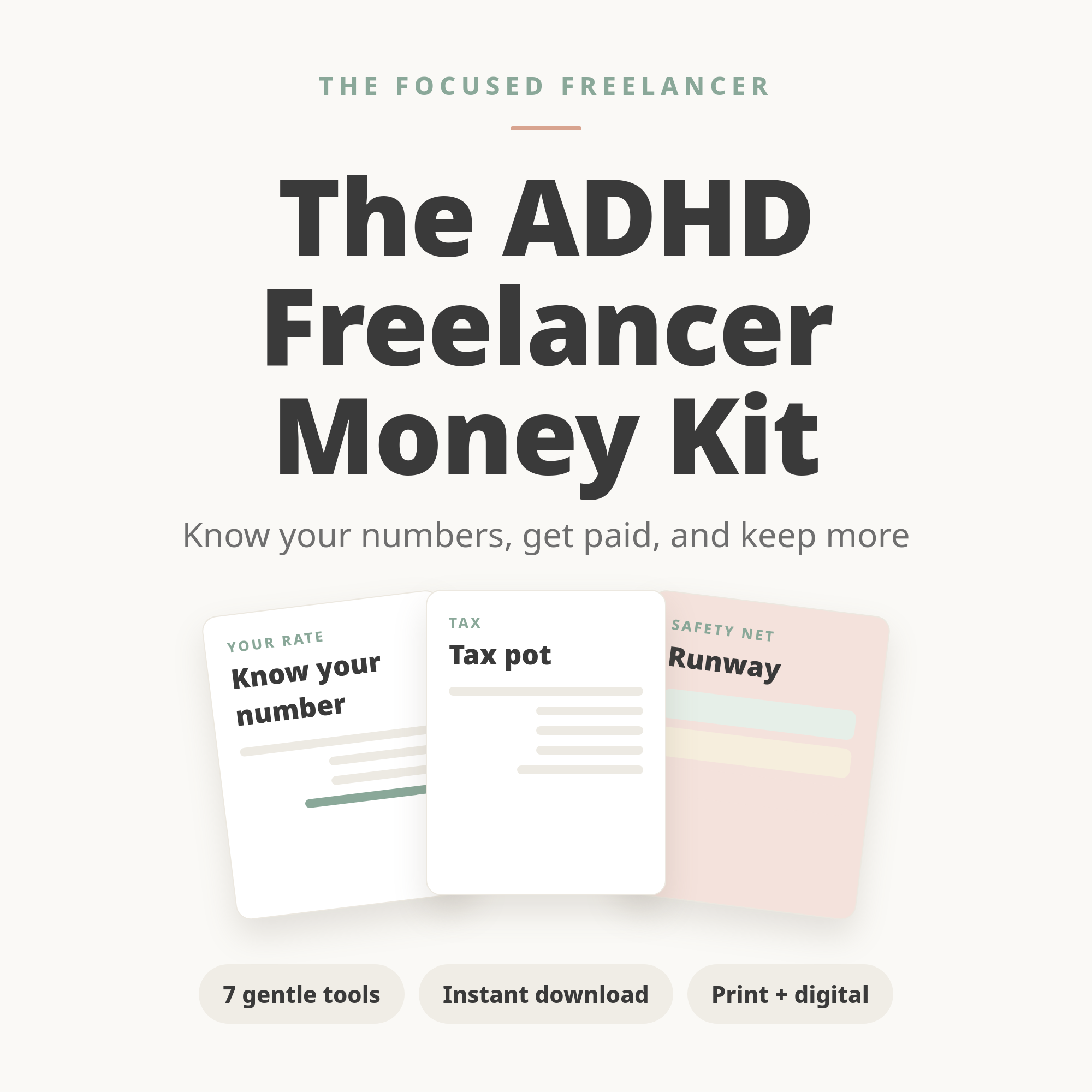
Losing track of who owes you what? The Money Kit includes a get-paid tracker that keeps every invoice, due date and chase in one place, so a late payment is something you notice on day one instead of six weeks later.
Day seven: the firm follow-up
Reply on the same email thread so the history sits underneath, and add a small amount of friction.
"Hi [Name], following up on invoice [number] for [amount], now seven days overdue. Could you confirm the payment date, or put me in touch with whoever handles accounts if that is easier? Happy to resend it in any format you need."
Offering to talk to the finance team is not a threat, it is genuinely useful. In a company of any size your contact often has no idea the invoice never got processed.
Day fourteen: name what happens next
This is where most freelancers stall, and where the tone has to change. Stay factual, drop the warmth, state a consequence you are actually willing to carry out.
"Hi [Name], invoice [number] is now fourteen days overdue and I have not had a payment date. I am pausing work on [current project] until it is settled. My terms include late fees from day thirty, which I would rather not apply. Can you confirm payment this week?"
Pausing work is the strongest lever you have, and it only works if you actually do it. Announcing a pause and then quietly carrying on teaches the client that your deadlines are soft.
Day thirty: the final notice
Short, dated, and clearly the last message before it stops being a conversation.
"Hi [Name], invoice [number] for [amount] is thirty days overdue. If payment is not received by [date, seven days out], I will pass this to [a collections service or a solicitor] and add the late fees set out in our terms. I would much rather settle it directly."
Then follow through. Most invoices never get this far, and the ones that do usually move the moment the client sees a real deadline attached to a real consequence.
Pick up the phone once
Somewhere around week two, call. Email is easy to leave unread and awkward to ignore in a voice. One two-minute call that ends with a named person and a date beats another four emails into a void. If phone calls are their own particular hell, a voice note or a short video call still gets you further than a fifth follow-up.
What not to do
Do not apologise for asking. Do not go silent for six weeks and then send something furious. Do not accept a vague "should be next week" more than twice without a date. And do not keep working for free while you wait, because unpaid work is the one thing that reliably makes a bad payer worse.
The takeaway
Getting paid is a process, not a personality trait. Deposit up front, invoice on delivery, chase on a fixed schedule with words you wrote once, and escalate on the dates you set rather than the day your patience runs out. It stops feeling like a fight and starts feeling like admin, which is exactly what it should have been all along.
Stop rewriting the chase email every time. The Money Kit is a printable set for freelancers who hate finance admin: an invoice and get-paid tracker, a tax-set-aside page, a monthly money check-in and an income planner for lumpy freelance months.